
The Rise of 48V: A New Foundation for Software-Defined Vehicles

As Software-Defined Vehicles (SDVs) and intelligent electric vehicles continue to evolve, modern automobiles are incorporating an increasing number of high-power electrical systems, including electric power steering, electric compressors, active suspension systems, and brake-by-wire actuators. As a result, traditional 12V electrical architectures are gradually reaching their limits in terms of power delivery and efficiency, driving the automotive industry to seek a more capable solution for future vehicle platforms.
In recent years, 48V electrical systems have rapidly evolved from a supporting technology used in mild hybrid vehicles into a critical enabler of next-generation intelligent mobility.
From 12V to 48V: More Than a Voltage Upgrade
The concept of 48V vehicle electrical systems is not entirely new. The European automotive industry began establishing relevant technical standards as early as 2011. However, due to cost considerations and ecosystem maturity, 48V systems were largely limited to start-stop applications, mild hybrid powertrains, and selected chassis control modules.
Today, the landscape is changing.
As vehicles become increasingly intelligent, power consumption across automotive electronic systems continues to rise. At the same time, a new generation of vehicle platforms is beginning to adopt 48V low-voltage architectures, allowing 48V systems to transition from a secondary supporting role to the core of modern vehicle electrical infrastructure.
From a technical perspective, 48V has gained significant industry attention because it represents an ideal balance between power capability, efficiency, and safety.
Compared with a 12V architecture, a 48V system can deliver approximately four times more power at the same current level. This enables support for a broader range of high-power loads while reducing cable size and wiring harness weight. The result is improved vehicle efficiency, greater design flexibility, and enhanced packaging opportunities for automakers.
Equally important, 48V remains below the internationally recognized 60V DC threshold for Safety Extra-Low Voltage (SELV). This allows manufacturers to avoid many of the expensive insulation and protection requirements associated with high-voltage systems while still achieving substantial gains in power delivery.
Today, many automakers employ a hybrid architecture that combines a 48V backbone with 12V subsystems. High-efficiency DC/DC converters enable compatibility between new and legacy systems, providing a practical migration path toward higher-performance vehicle electrical architectures.
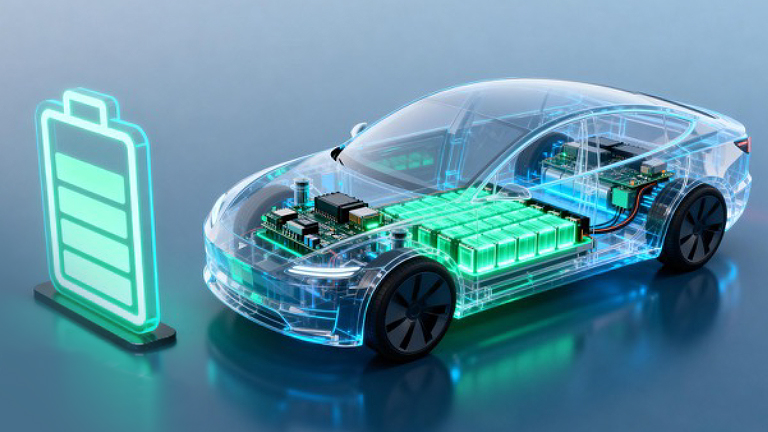
New Engineering Challenges Accompany Higher Voltage Levels
While moving to 48V unlocks significant benefits, it also introduces new engineering challenges.
As system voltage increases from 12V to 48V, power devices must operate under substantially more demanding conditions. Power semiconductors such as MOSFETs not only need to withstand higher operating voltages, but also transient voltage spikes generated by parasitic inductances within wiring systems. Consequently, device voltage ratings often need to increase from approximately 40V to 75V or even 100V.
However, higher voltage ratings typically come with trade-offs, including increased on-resistance and switching losses. For engineering teams, balancing efficiency, thermal performance, and long-term reliability becomes a critical challenge in 48V system development.
As a result, comprehensive component evaluation, power-stage optimization, and thermal management validation have become essential practices during the early stages of vehicle design. These measures are increasingly viewed as key strategies by vehicle manufacturers and Tier 1 suppliers seeking to maximize system performance and reliability.
Functional Safety Takes Center Stage
Beyond power management considerations, functional safety has emerged as another key focus area in the adoption of 48V architectures.
As vehicles progress toward Level 3 and higher autonomous driving capabilities, critical systems such as steering, braking, and chassis control must maintain operation even when primary power pathways experience failures. This Fail-Operational capability has become a fundamental requirement for future intelligent vehicles.
To meet these requirements, traditional single-path power distribution architectures are increasingly being replaced by redundant power systems. Through the combination of electronic fuses (eFuses) for fault isolation and ideal diode controllers for seamless power-path switching, automotive designers can significantly improve system resilience and reduce the risks associated with single-point failures.
Meanwhile, the role of the Battery Management System (BMS) is evolving as well. Rather than functioning as a standalone battery monitoring unit, modern 48V BMS platforms must collaborate closely with high-voltage battery systems, zonal controllers, and vehicle energy management systems to support intelligent power allocation and dynamic energy management across the vehicle.
48V Is Moving Toward the Mainstream
Based on current industry trends, 48V electrical systems are no longer viewed as a transitional technology. Instead, they are increasingly recognized as one of the foundational building blocks for next-generation intelligent electric vehicles.
By addressing the power and efficiency limitations of traditional 12V systems while maintaining strong safety performance, cost effectiveness, and scalability, 48V architectures offer a compelling path forward for the automotive industry.
As advanced chassis systems, brake-by-wire technologies, autonomous driving functions, and intelligent comfort features continue to proliferate, the 48V ecosystem is expected to mature rapidly. Looking ahead, achieving the optimal balance among power semiconductors, battery management technologies, and functional safety requirements will remain a key priority for automakers and suppliers alike as they shape the future of intelligent mobility.
