
with Microchip Switchtec™ Gen4 PCIe® Switches
As data-intensive applications continue to expand across data centers, industrial systems, medical imaging and AI acceleration, system designers are under increasing pressure to move larger volumes of data between processors, accelerators and high-speed endpoints. PCI Express® has become a critical high-speed interconnect for these applications, but increasing system complexity makes PCIe architecture, signal integrity, scalability and system validation increasingly challenging.
Microchip’s Switchtec™ Gen4 PCIe® switch technology and evaluation board reference design provide developers with a proven platform for building and evaluating scalable PCIe architectures while reducing development effort and design risk.

The Challenge: Connecting More High-Speed Devices
Modern computing architectures rarely consist of a processor connected to a single peripheral. Data center servers, industrial computing platforms, ultrasound imaging systems and medical AI accelerator cards may need to connect CPUs with NVMe storage, GPUs, FPGAs, accelerators and other PCIe endpoints.
As the number of devices increases, designers must address several challenges:
- Expanding PCIe connectivity beyond the lanes directly available from the host processor
- Supporting different endpoint configurations and lane widths
- Maintaining high data throughput with low latency
- Managing errors and isolating faults
- Maintaining signal integrity across high-speed PCIe links
- Debugging increasingly complex PCIe topologies
- Reducing development and system validation time
A PCIe switch provides an effective way to solve these challenges by creating a flexible switching layer between the CPU root complex and multiple endpoints.
Flexible PCIe Gen4 Connectivity with Switchtec
Microchip’s Switchtec PFX Gen4 family provides high-performance, non-blocking PCIe Gen4 switching for applications requiring large numbers of PCIe endpoints.
The family supports PCIe Gen4 operation at 16 GT/s and is available in configurations ranging from 28 to 100 PCIe lanes. Depending on the device, designers can implement as many as 52 ports, 48 non-transparent bridges and 26 virtual switch partitions.
Ports can be configured with x1, x2, x4, x8 or x16 lane widths, enabling a PCIe architecture to be adapted to different processors, storage devices and accelerator requirements.
This flexibility makes the platform particularly useful when multiple high-bandwidth endpoints need to communicate efficiently within a single system.
Designed for High-Reliability Systems
Performance alone is not sufficient for data center, industrial and medical applications. Reliability and fault isolation are equally important.
Switchtec PFX devices incorporate PCIe reliability features including Advanced Error Reporting (AER) on all ports and Downstream Port Containment (DPC) on downstream ports. Additional capabilities include poisoned TLP blocking, Completion Timeout Synthesis and hot- and surprise-plug controllers.
The architecture also supports end-to-end data integrity protection and ECC protection for internal memories.
These capabilities help designers contain PCIe faults and build more resilient systems, particularly where multiple high-value endpoints share the same PCIe fabric.
Simplifying PCIe Debug and Signal Integrity Analysis
As PCIe data rates increase, system validation becomes an important part of the development cycle.
Microchip provides access to its ChipLink Diagnostics Tool, offering configuration, diagnostics, functional debugging and signal integrity analysis through a graphical interface.
Engineers can access configuration and management functions and perform tasks such as real-time eye capture. Switchtec devices also provide capabilities including a Transaction Layer Packet generator, performance and error counters, TLP latency monitoring and loopback functionality.
Together, these capabilities give developers greater visibility into the PCIe fabric and can simplify troubleshooting during system bring-up.
A Proven Reference Design to Accelerate Development
To help developers move from device evaluation to system implementation more quickly, Microchip provides the Switchtec Gen4 PCIe Switch Evaluation Board Reference Design.
The evaluation platform places the PCIe switch within a complete supporting architecture, providing the devices required for interaction between a CPU root complex and PCIe endpoints.
The reference design incorporates not only the Switchtec PCIe Gen4 switch but also supporting Microchip technologies for clock generation and distribution, FPGA/CPLD control, Ethernet connectivity, identification and power regulation.
Key components include:
- Switchtec™ PCIe® Gen4 switches: PFX, PSX and PAX Gen4 families
- ZL30265: DUT and auxiliary PCIe clock source
- ZL30265/ZL30263/ZL30231 and ZL40293: clock distribution and fanout
- A3PE3000L: ProASIC®3L low-power flash FPGA
- VSC8540X: single-port Gigabit Ethernet PHY
- 24AA02UID: EEPROM with unique device identification
- LX7302, LX7104 and LX7165: power regulation devices
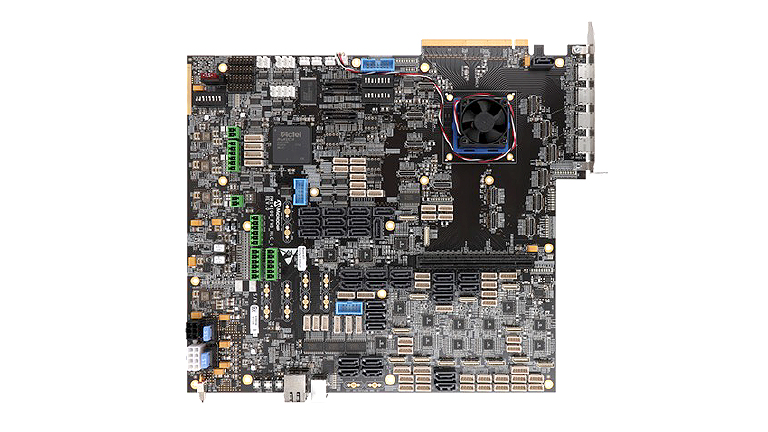
By combining the switch with its supporting clocking, control, networking and power architecture, the reference design gives engineers a more complete starting point than evaluating the PCIe switch in isolation.
Supporting Data Center, Industrial and Medical AI Architectures
The scalability provided by PCIe switching can benefit a wide range of applications.
Data Center and Edge Computing
Servers and edge computing platforms increasingly combine CPUs with NVMe storage and hardware accelerators. Switchtec devices can provide the PCIe fanout needed to connect these resources while maintaining high-performance communication between hosts and endpoints.
Industrial Computing
Industrial servers and high-performance embedded platforms can use flexible PCIe switching to integrate storage, FPGA-based processing, networking and other high-speed peripherals. Error containment and diagnostic capabilities can be particularly valuable in systems where reliability and serviceability are important.
Ultrasound Imaging
Modern ultrasound systems process significant volumes of imaging data. A scalable PCIe architecture can provide high-speed connectivity between processors, acquisition hardware, storage and image-processing accelerators.
Medical AI Accelerator Cards
AI-assisted medical applications increasingly rely on GPUs, FPGAs or dedicated accelerator devices. PCIe switching can expand connectivity between host processors and these accelerators while providing flexible lane allocation as system architectures evolve.
Key Benefits
Using the Switchtec Gen4 PCIe Switch Evaluation Board Reference Design can help development teams:
- Accelerate time to market with a fully tested and validated reference platform
- Reduce design risk by starting from a proven PCIe architecture
- Scale system connectivity with up to 100 PCIe lanes and flexible port configurations
- Improve reliability through comprehensive PCIe error detection and containment features
- Simplify system debugging with ChipLink configuration, diagnostics and signal integrity analysis
- Optimize board design by leveraging an integrated solution covering PCIe switching, clocking, control and power
- Access expert technical support during development
From Evaluation to System Deployment
As high-performance computing moves beyond traditional servers into industrial, imaging and AI-enabled systems, PCIe connectivity is becoming an increasingly important part of overall system architecture.
Microchip’s Switchtec Gen4 PCIe switch family combines scalable PCIe fanout, flexible topology options, reliability features and comprehensive diagnostics. Combined with the Switchtec Gen4 PCIe Switch Evaluation Board Reference Design, developers gain a validated platform that can help shorten the path from initial evaluation to a production-ready system.
For designers developing data center equipment, industrial computing platforms, ultrasound imaging systems or medical AI accelerators, the solution provides a practical foundation for building scalable and reliable high-speed PCIe connectivity.