
Wireless sensing technologies usher in the seamless era

As you walk toward your spot in the underground parking garage, shopping bags in both hands, your car’s lights turn on without a sound, casting a welcoming carpet of light over the pavement. As you get closer, the driver’s side door gently unlocks. You then approach the rear of the car, and the trunk automatically pops open with no key or phone touch required.
This isn’t a solo performance – it’s a “symphony” orchestrated by wireless sensing technologies such as Bluetooth, Wi-Fi, UWB, and IMU. Each technology plays a part in a greater harmony, allowing smart devices to precisely perceive space, understand the environment, and even anticipate your intentions.
Positioning and wake-up – BLE’s low-power “whisper”
This collaborative performance begins with a low-power “gentle wake-up” from Bluetooth Low Energy (BLE). It’s like a vigilant guard who’s always on duty, yet barely uses any power at all.
When a BLE-equipped smartphone or smartwatch approaches within 10 – 30 meters of the vehicle, a connection is established between the vehicle and device through a series of continuously broadcasted signals.
In the consumer electronics space – from wireless earbuds and smart bracelets to smart door locks – BLE has long been the unsung hero, quietly maintaining connections in the background. Its primary mission isn’t precise positioning, but rather efficient identification and wake-up. It tells the system: “An authorized user is approaching.”
Precise ranging and spatial awareness – the “centimeter-level conversation” of UWB and Bluetooth channel sounding
Once awakened by BLE, the system needs to know: “Where exactly is the user? And what do they want to do?” That’s when technologies capable of centimeter-level conversation come into play.
Ultra-Wideband (UWB) technology acts like a radar, measuring distance by calculating the time of flight of radio waves between two devices, achieving positioning accuracy down to the centimeter. In automotive scenarios, it can precisely determine whether the user is standing by the driver’s door, passenger door, or trunk. This enables seamless, secure door unlocking and a personalized welcome. It also effectively resists relay attacks.
As a rising star in the Bluetooth family, Bluetooth channel sounding (CS) technology offers a new high-precision path. It leverages phase information across multiple channels for ranging, delivering decimeter- to centimeter-level accuracy. Its main advantage is that it can reuse the Bluetooth hardware already present in devices, bringing high-precision positioning to more devices at a much lower cost.
Posture, intention, and seamless transitions – the “contextual understanding” of IMU and Wi-Fi
Once the system knows your precise location, the next step is understanding your posture and intention. That’s where the inertial measurement unit (IMU) kicks in. The IMU built into your smartphone or smartwatch can use the gyroscope and accelerometer to sense whether you’re walking, running, or simply raising your arm to check your watch. When combined with location data, the system can deduce, for example, that you’re heading toward the trunk with something heavy in your hands.
Wi-Fi plays a dual role here: it acts as both a high-speed data channel and a wide-area positioning anchor. As you walk from your house to garage, your phone transitions from the home Wi-Fi network to the vehicle’s Wi-Fi hotspot in a seamless handover. Indoors, Wi-Fi can also help with room-level positioning by complementing BLE’s coarse location estimates and filling in the gaps.
An application symphony: From automotive to all-scenario smart fusion
This collaborative logic is rapidly expanding from premium vehicles into the entire consumer electronics and IoT ecosystem. For example:
Smart home scenarios: As you approach your front door with your phone in hand, BLE gently wakes up the smart door lock. Once UWB confirms your position right at the doorstep, the door automatically unlocks and swings open. Stepping into the living room, your phone seamlessly switches to the home Wi-Fi network. At the same time, the IMU detects the motion of you sitting down, and the lights instantly adjust to comfort mode.
AR/VR and indoor navigation: In large shopping malls or museums, BLE beacons handle zone wake-up and coarse positioning, while UWB or Bluetooth CS delivers centimeter-level accuracy for precise store navigation or exhibit guidance. And the IMU ensures continuous posture and motion tracking.
Asset tracking and personnel management: In factories or warehouses, tags attached to key tools or assets work together seamlessly. BLE broadcasts their presence, UWB reports their exact location with high precision, and the IMU detects whether the item has been moved or accidentally dropped, delivering end-to-end, fine-tuned management.
Building the “invisible, seamless” core experience
The ultimate goal of this technological symphony is to create an “invisible and seamless” experience. Moving ahead, these technologies will continue to converge. We may even see integrated single-chip solutions that combine multiple technologies, further lowering power consumption and costs. At the same time, on-device AI will enable devices to process sensor-fusion data with localized language support, learn user habits more intelligently, and anticipate needs while protecting user privacy.
Take the evolution of Bluetooth as an example: Bluetooth CS, a flagship new feature in Bluetooth 6.0, is taking traditional connectivity into a new era of centimeter-level precise positioning. Avnet, working hand-in-hand with ecosystem partners, provides developers with end-to-end support – from chips all the way to complete solutions. For example, the nRF54L15 series SoC launched first by Nordic Semiconductor, and the MCX W72/KW47 wireless MCU series optimized by NXP Semiconductors for automotive and industrial IoT both support this cutting-edge technology.
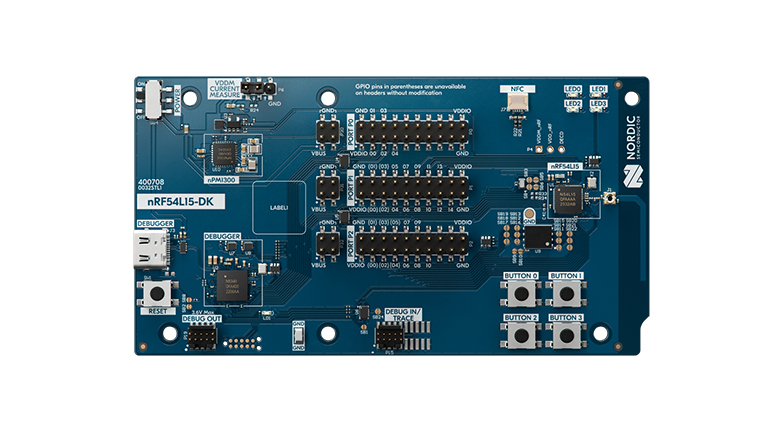
nRF54L15 Development Kit
Avnet provides more than just the hardware – it also supports developers in addressing key challenges such as antenna configuration, power consumption optimization, and integration of core ranging algorithms through accompanying SDKs, development kits, and professional tech support. They are committed to ensuring that their partners’ products achieve the best possible balance between interoperability and performance.
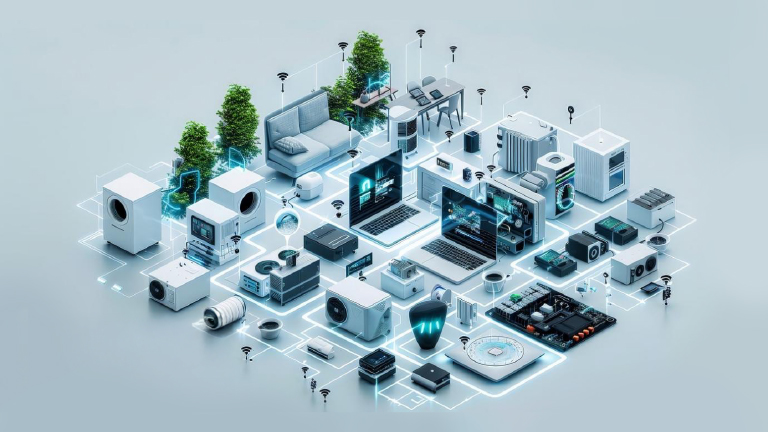
When technological collaboration approaches perfection, the experience becomes supremely natural. Spaces understand you, devices assist you, and you become completely unaware of the intricate web of underlying technologies. This is the future that collaborative wireless sensing technologies is ushering in – a smarter, smoother space where the digital and physical worlds converge and merge, seamlessly.
Content reference: Bluetooth Channel Sounding takes positioning to a new level
