
Wired together: How automation systems power the Industrial Internet of Things
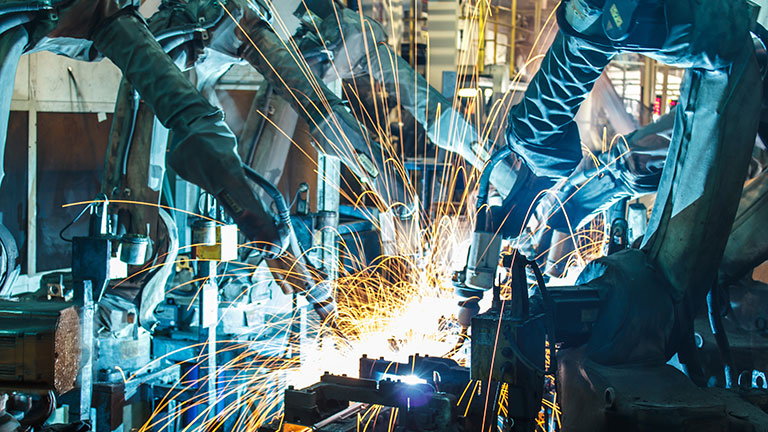
The Industrial Internet of Things, or IIoT, places renewed focus on data collection in order that factories, suppliers and customers can share their digital knowledge. From process control and automotive assembly, to robotics and the food and beverage industry, the concept behind Industry 4.0 touches all industries.
Critical to the success of this digital future are reliable wired interfaces that can withstand the harsh environments where data communication between PLCs, sensors, actuators and motors takes place.
Over the past few years there has been a steady trend toward Ethernet-based industrial networks and a move away from traditional fieldbus technologies. 2018 saw installed industrial Ethernet nodes overtake fieldbus networks for the first time, with all indications showing that the trend will continue. Compared to fieldbus protocols, Ethernet provides a high-speed, low jitter and deterministic solution that is easily implemented on current Ethernet hardware. This makes it highly suitable for motor control applications in particular.
Classic Ethernet has not, until recently, been able to reserve bandwidth or guarantee latency between nodes, a must for industrial networks. Changes such as Time-Sensitive Networking (TSN), described in IEEE 802.1AS and a profile of the IEEE 1588 Precision Time Protocol (PTP) standard, tackle this challenge. However, support for TSN requires hardware changes to Ethernet nodes. Existing industrial Ethernet-based protocols such as EtherCAT already provide low jitter, less than 1µs and equivalent to IEEE1588, implemented in software using existing Ethernet MAC hardware.
Ethernet/IP, the fastest growing technology, and PROFINET, along with EtherCAT, remain the most popular Ethernet-based networking solutions in Europe, with Modbus-TCP also having a notable share. In the US, CIP networks still dominate the market but there is a clear trend towards Ethernet/IP. PROFIBUS, Modbus-RTU and CC-Link remain the dominant fieldbus protocols, followed by CANopen and DeviceNet and, despite the general trend to Ethernet, there is still annual growth in the number of nodes being installed.
The best connector solution for the task at hand
Selecting the optimum connector for the chosen network is a task fraught with challenges. The considerations start with the number of connections required and the voltages and currents that will need to flow across the connector. Additionally, it is necessary to consider how often the connector will have to be inserted and removed, and whether this process may need to be done blind. Environmental conditions will also influence the decision, requiring the industrial engineer to review the temperature of the operating environment along with the potential impact of liquids, as well as electromagnetic compatibility challenges.
Even when all of these considerations have been made, there is also the issue of handling during installation or cable manufacture. Connectors offer a range of construction options, from crimped and screwed pins to piercing and solder, to name but a few. If connectors will need to be installed on-site at your client’s facility, especially if the location is challenging, such as up a ladder at ceiling level or hidden in a cabinet, the choices made here could have a significant impact on installation time and reliability of the final installed result.
Take a deep dive into the wired connectivity solutions available in our whitepaper, Connectors for Industrial IoT.
