
4D imaging millimeter wave radar equips vehicles with superhuman vision

Imagine a car driving in the rain. The camera lens is blurred by rainwater, and the LiDAR’s accuracy is inevitably compromised. And yet even in these conditions, the millimeter wave radar system clearly outlines the contours of key targets on the road ahead. This is the future of advanced driver assistance systems (ADAS) in the era of intelligent vehicles. Advances in sensor technology, AI algorithms, and energy-efficient microprocessors have seen ADAS become a standard feature in modern automobiles. However, most ADAS systems rely primarily on forward-facing perception with a field of view limited to 90 to 120 degrees. Even when multiple cameras are used to achieve a 360-degree field of view, accuracy in spatial precision and object detection is lacking.
Radar technology: The all-weather eye of vehicles
Among the various sensor technologies in ADAS, radar stands out as one of the few that can operate reliably in almost all environmental conditions – day and night, in rain, fog, and snow.
Since the performance of radar is significantly less affected by environmental factors than other types of sensors, it has become a core component of ADAS applications. Furthermore, thanks to its cost advantages, radar technology enables automakers to reduce overall system costs.
However, before it becomes the primary sensor technology in ADAS, radar needs to achieve more precise target identification and higher spatial resolution. While larger apertures can improve the detection accuracy of radars, they require more physical space. Especially in the case of front-mounted radars, this can often impact the vehicle’s exterior design.
Distributed aperture radar: Overcoming physical constraints
Distributed aperture radar (DAR) is fast emerging as a groundbreaking solution. This technology overcomes the physical limitations of traditional radar by using two or more physically separated, forward-facing mid-range radar sensors. Through close coordination between multiple sensors and sensor fusion technology, DAR forms a large virtual aperture, delivering azimuthal resolution of 0.5 degrees or even smaller, and dramatically improving spatial resolution.
This superior resolution enables better detection of closely spaced objects, resulting in more accurate vehicle positioning and object recognition. Studies show that adding a third sensor can further enhance performance. Compared to conventional radar systems, DAR achieves superior performance without the bulky hardware, effectively overcoming the integration challenges faced by automakers.
4D imaging radar: The future of sensing technology
Fully realizing navigation on autopilot (NOA) requires three primary sensing technologies: camera lens, millimeter wave, and LiDAR. With their respective strengths and limitations, the three complement one another.
While LiDAR has undisputed high resolution, the rapid advancement of 4D imaging millimeter wave radar is quickly positioning it as a viable alternative to LiDAR in many application scenarios.
4D imaging millimeter wave radar provides detection across four dimensions –range, velocity, azimuth, and elevation, enabling true three-dimensional spatial perception. Many automakers are already replacing – or planning to replace – LiDAR with the more cost-effective 4D imaging millimeter wave radar.
Gasgoo Automotive Research Institute reports that the market penetration rate of L2 and higher autonomous driving features as standard equipment in passenger vehicles is expected to exceed 90% by 2030. This forecast highlights the vast future potential of 4D imaging millimeter wave radar in the automotive industry.
Avnet’s 4D radar solution: Redefining the performance boundaries of 4D radar
Avnet's S32R41 + 2×TFE82 dual-chip cascade program represents the cutting edge of 4D imaging millimeter wave radar technology.
This solution advances the technology in three key areas.
Firstly, Avnet’s 4D radar solution offers outstanding RF front-end sensing. Since 4D imaging millimeter wave radar must accurately detect small targets, such as pedestrians and bicycles, it requires precise long-range detection and reliable differentiation of small objects. The optimized RF performance significantly boosts detection capability and resolution by improving the RF link budget, output power, noise figure, and phase noise. The TEF82 RFCMOS automotive radar transceiver is a high-performance, single-chip, low-power solution operating in the 76–81 GHz band, covering the full automotive radar frequency spectrum.
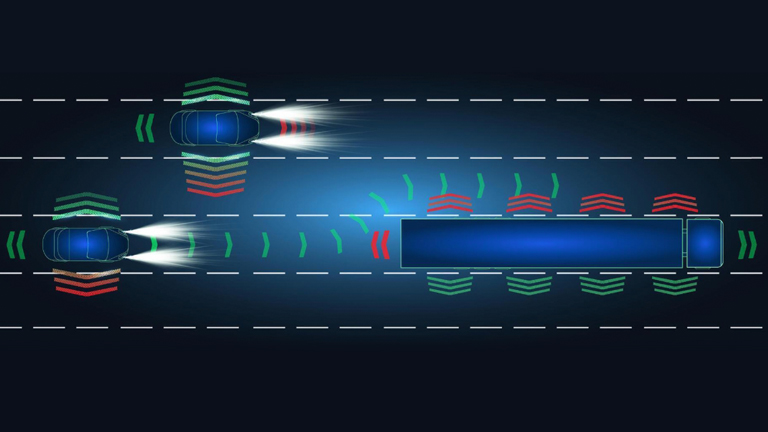
Secondly, Avnet’s 4D radar solution possesses powerful data processing capabilities. The S32R41 processor provides exceptional computing power, enabling the radar to process massive amounts of data in real time and generate accurate 3D position + velocity environmental images. By adopting multiple-input multiple-output (MIMO) technology, the radar system gains access to far more virtual channels, dramatically improving the accuracy and range of target detection and tracking.
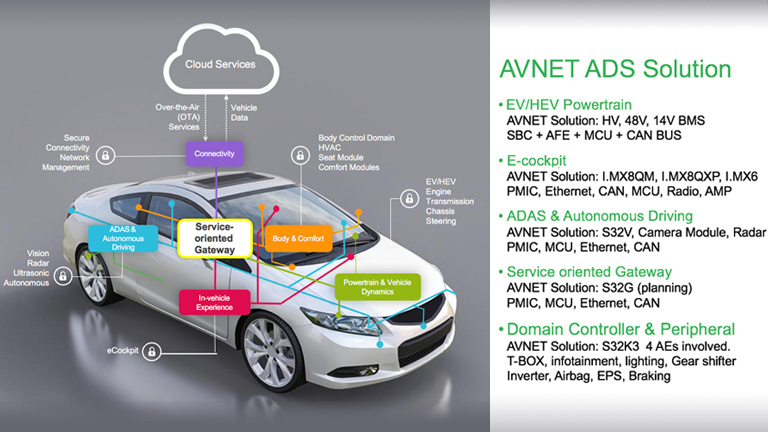
Thirdly, Avnet’s 4D radar solution boasts an innovative development toolkit and ecosystem. Avnet also offers antenna reference designs, matched radar calibration algorithms, and a user-friendly development environment. This allows RF engineers to easily evaluate the TEF82's RF performance, and algorithm engineers to efficiently develop and validate their own algorithms, thus accelerating the development cycle.
As technology continues to evolve, next-generation ADAS systems will no longer rely solely on a single sensor technology but will move toward multi-technology fusion. The intelligent integration of 4D imaging millimeter wave radar with camera lenses and LiDAR will create a safer and more reliable autonomous driving experience.
In the future, automobiles will no longer be just vehicles for transportation; they will be smart companions equipped with superhuman powers of perception.
