Gartner点名的2026核心趋势:物理AI到底在改变什么?
Global IT research and advisory firm Gartner has identified “Physical AI” as one of the Top 10 Strategic Technology Trends for 2026. This signals a major industry shift—AI is no longer confined to digital or virtual environments. Instead, it is rapidly moving into the physical world, embedding itself into real-world operations.
This transformation marks the accelerating rise of autonomous machines, where AI systems can not only “understand” but also interact with and control the physical environment. As a result, Physical AI is transitioning from research labs into real-world industrial applications.
The Core Challenges of Autonomous Machines
The working logic of autonomous machines can be compared to the human process of:
“Perceive – Think – Act.”
- Sensors capture environmental data (“perception”)
- Edge AI processes and interprets the data (“thinking”)
- Execution systems perform actions (“act”)
This entire loop must be completed within milliseconds. In high-speed production environments, even a few milliseconds of delay can lead to reduced product quality—or even safety incidents.
To enable this real-time closed-loop operation, two foundational technologies are critical:
- High-speed interconnect
- Fine-grained power management
The former determines whether massive amounts of data can be transferred in real time, while the latter determines whether machines can operate sustainably under constrained energy conditions.
Interconnect: The “Nervous System” of Autonomous Machines
During operation, autonomous machines continuously generate and transmit large volumes of multi-source data:
- Vision data from cameras
- Tactile feedback from torque sensors
- Real-time joint position data
All of this information must be rapidly aggregated, processed, and acted upon within a central system—essentially functioning like a digital nervous system.
In scenarios where multiple autonomous robots collaborate (such as synchronized assembly lines), microsecond-level synchronization is required.
In this context, optical modules offer key advantages:
- High bandwidth
- Low latency
- Strong interference immunity
They are therefore an ideal solution for high-speed machine-to-machine interconnect. Combined with on-chip SerDes interfaces, optical modules maintain signal integrity over longer distances, ensuring reliable and low-jitter communication across distributed systems.
To address the combined requirements of high-speed connectivity, real-time AI inference, low power consumption, and compact design, Avnet has introduced a range of “ready-to-deploy” AI solutions based on NXP’s MCX N series microcontrollers.
These solutions provide:
- High efficiency
- Reliability
- Flexibility
—enabling customers to rapidly deploy machine learning applications and accelerate the adoption of edge intelligence.
High-Performance Processing Platform

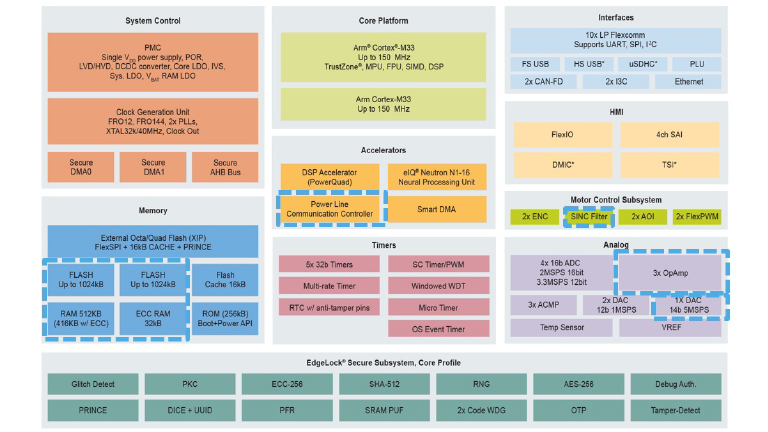
The NXP MCX N94x and MCX N54x series microcontrollers feature:
- Dual-core high-performance Arm® Cortex®-M33 processors
- Clock speeds up to 150 MHz
- Up to 2MB Flash with optional ECC RAM
- Integrated DSP co-processor
- eIQ Neutron Neural Processing Unit (NPU)
The NPU delivers up to 42× higher machine learning inference throughput compared to a single CPU core. This significantly reduces processor wake-up time and lowers overall system power consumption, making it ideal for autonomous machines that demand low latency and high energy efficiency.
Power Management: Enabling Machines to Run Longer
In April 2026, a humanoid robot half-marathon in Beijing highlighted the challenges of power consumption. During the ~21 km race, many robots struggled with:
- Heat buildup
- Limited battery life
Some teams even had to adopt battery-swapping strategies to complete the race.
This real-world scenario underscores a critical issue: power consumption is a key bottleneck for long-duration autonomous operation.
While battery technology continues to improve, effective power management remains the true differentiator for achieving long endurance.
From DVFS to AI-Driven Power Optimization
Dynamic Voltage and Frequency Scaling (DVFS) has long been used in computing to balance performance and energy efficiency:
- High load → Increase voltage and frequency
- Idle state → Reduce frequency or enter sleep mode
Emerging approaches focus on finer-grained DVFS strategies, such as:
- Reducing response time from milliseconds to microseconds
- Combining DVFS with edge AI-based power management systems
With AI models predicting workload demand, systems can proactively adjust power states—achieving better efficiency than traditional reactive methods.
Intelligent Multi-Level Power Control
Edge AI power management systems can also:
- Dynamically switch between multiple sleep states
- Maintain shallow sleep for quick wake-up during short tasks
- Enter deep sleep during idle periods for maximum energy savings
Achieving this requires coordinated optimization across:
- Hardware
- Firmware
- Software
No single layer alone can solve the complexity of power management in autonomous systems.
From Components to Full Ecosystem Enablement
Whether enabling high-speed interconnect (the “nervous system”) or advanced power management (long-term endurance), the industrialization of Physical AI depends on a complete ecosystem—from components to system integration.
Avnet leverages its expertise in electronic component distribution and technical support to provide:
- End-to-end services from technology selection to mass production
- Access to a global supplier network
This enables customers to quickly source key components such as:
- Chips
- Optical modules
- Wireless modules
- Sensors
—significantly shortening the time from proof of concept to product launch.